The best AI search monitoring tools help you track your brand’s visibility and mentions in answers generated by ChatGPT, Gemini, Claude, Perplexity, and other LLM platforms. In this guide, we reviewed six of the best AI search monitoring tools on the market, including RankLLM, Knowatoa, and Peec AI. We compared their key features, LLM coverage, pricing, pros, cons, and ideal use cases. The comparison makes it easier to see how each platform differs and choose the right one for your AI visibility goals.
Here are our top three picks:
| Tool | Best For |
| RankLLM | Brands monitoring AI visibility and finding listicle opportunities |
| Knowatoa | Brands tracking specific customer questions and AI crawler access |
| Peec AI | Teams needing detailed competitor and citation analysis |
What are AI search monitoring tools?
AI search monitoring tools are software platforms that track how brands and products appear in responses generated by large language models and AI search engines such as ChatGPT, Gemini, Claude, Perplexity, and Google AI Overviews.
Why AI search monitoring tools matter?
AI search is becoming an important discovery and acquisition channel for brands. Adobe Digital Insights reported that traffic from AI sources to U.S. retail websites increased 393% year over year during the first quarter of 2026. The findings were based on more than one trillion visits to U.S. retail websites.
The commercial value of this traffic is also increasing. Similarweb found that ChatGPT-referred visitors converted at 7.1%, outperforming organic search, direct traffic, social media, email, and display advertising across the websites it analyzed in April and May 2026.
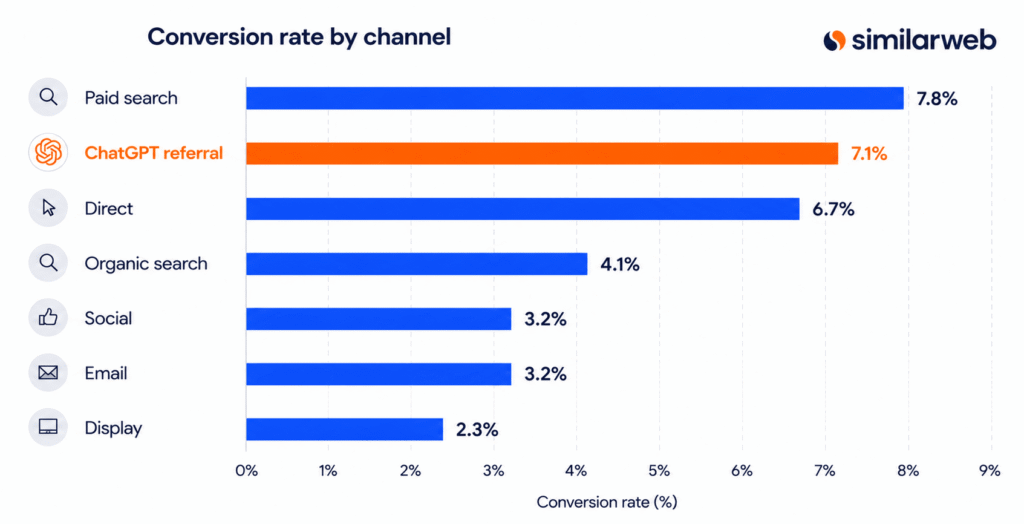
Source
As AI platforms become a larger part of the customer journey, brands need AI search monitoring tools to understand where they appear, how they compare with competitors, and which sources influence LLM-generated recommendations.
Key features to look for in AI search monitoring tools
When comparing AI search monitoring tools, look for features such as:
- Multi-engine tracking: Covers major AI platforms.
- Prompt tracking: Monitors relevant customer questions.
- Prompt discovery: Finds new queries worth tracking.
- Regional tracking: Compares results across markets.
- Citation tracking: Identifies cited websites and pages.
- Citation gap analysis: Finds sources citing competitors but not your brand.
- Competitor benchmarking: Compares visibility and share of voice.
- Sentiment analysis: Tracks positive, neutral, or negative mentions.
- Hallucination detection: Flags inaccurate or outdated brand information.
- Historical reporting: Measures visibility changes over time.
- Actionable recommendations: Suggests content, technical, and outreach improvements.
- Workflow integrations: Connects with SEO and content tools.
6 best AI search monitoring tools in 2026
We evaluated each platform based on its AI platform coverage, prompt tracking, citation analysis, competitor insights, reporting, pricing, and ideal use cases. We also assessed how effectively each tool turns visibility data into practical recommendations.
Now, let’s take a closer look at the six best AI search monitoring tools.
| Tool | Best For | AI Platform Coverage | Starting Price |
| RankLLM | Tracking AI visibility and finding listicle and citation opportunities | ChatGPT, Gemini, and Claude | $20/month; free plan available |
| Knowatoa | Tracking specific customer questions and AI crawler access | Seven platforms, including ChatGPT, Claude, Gemini, Perplexity, Meta AI, AI Overviews, and AI Mode | $59/month |
| Peec AI | Detailed competitor and citation analysis | Six standard model options; up to 11 models on Enterprise | $95/month |
| GetMint | Turning AI visibility gaps into content opportunities | 10+ engines, including ChatGPT, Gemini, Claude, Perplexity, and AI Overviews | $80/month |
| Scrunch | Enterprise AI search monitoring and AI agent accessibility | Four LLMs on Core; nine on Enterprise | $250/month |
| Goodie | Managing an end to end AEO program | Three models on Explorer; up to 11 models on Enterprise | $399/month |
1. RankLLM
Best for tracking AI visibility + finding listicle and citation opportunities
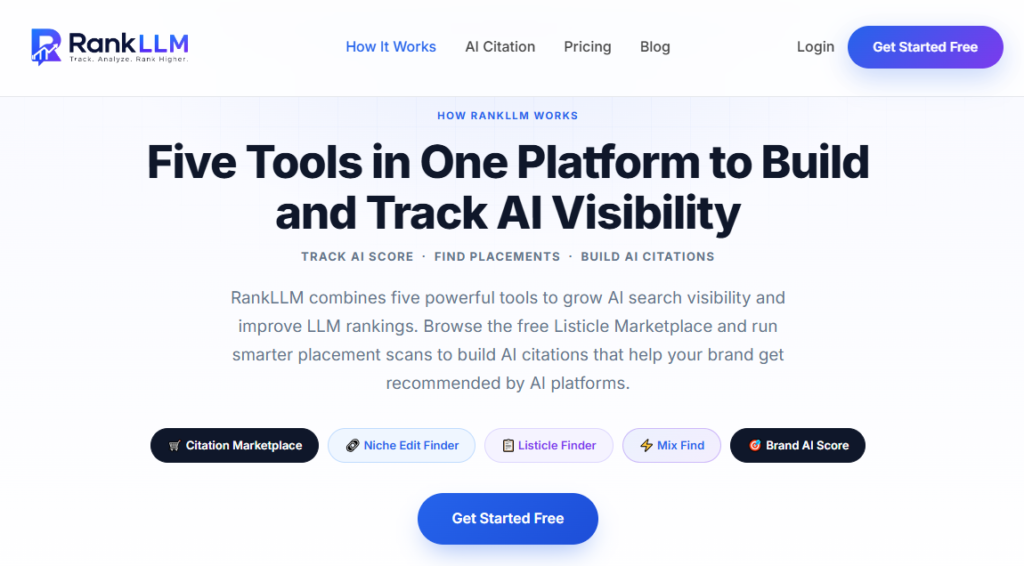
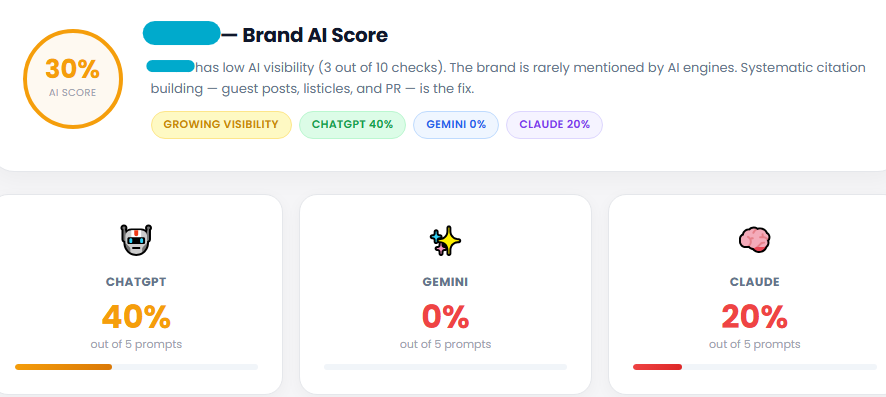
RankLLM is an AI search visibility and citation building platform that shows how often a brand appears across ChatGPT, Gemini, and Claude. Its Brand AI Score runs 15 live recommendation checks and converts the results into separate engine scores and one overall visibility score.
What makes RankLLM different from other AI search monitoring tools is its focus on action. Alongside visibility tracking, it helps users find listicles, comparison pages, and existing articles where their brand could earn a relevant mention. This makes it best suited to SaaS brands, SEO teams, and agencies that want to combine AI visibility monitoring with citation outreach.
Key Features
- Brand AI Score: Measures brand visibility across ChatGPT, Gemini, and Claude using 15 live prompts. It provides a separate score for each engine and an overall visibility score from 0% to 100%.
- Citation Marketplace: Lists live article and listicle placement opportunities with details such as niche, domain rating, traffic, and pricing. Users can contact publishers directly from the platform.
- Listicle Finder: Finds roundup, comparison, and “best tools” articles where a brand could be added. It also suggests the ideal position, listing copy, and placement instructions.
- Niche Edit Finder: Identifies existing articles where a brand mention or backlink could fit naturally and provides revised wording for the suggested edit.
- Mix Find: Runs both placement searches on the same domain and recommends whether a listicle placement or niche edit is the stronger opportunity.
- Editor Briefs: Produces ready-to-send outreach instructions with suggested copy, anchor text, and placement details.
Pros
- Combines AI visibility tracking with placement discovery
- Offers a free marketplace without requiring a paid subscription
- Helps users move from identifying weak visibility to finding outreach opportunities
- Generates suggested copy and editor briefs for each placement
- Starts at $20 per month, making it accessible to smaller teams
- Supports up to 50 brands and unlimited scans on the Agency plan
Cons
- Visibility tracking currently covers only ChatGPT, Gemini, and Claude
- The platform is relatively new
Pricing
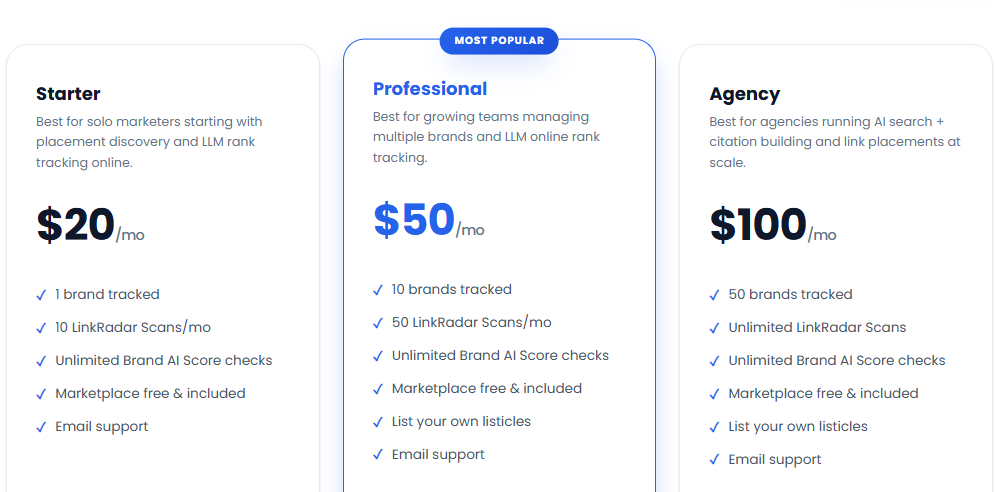
RankLLM offers a free account and three paid plans:
- Free: Citation Marketplace access and one Brand AI Score check.
- Starter: $20/month for one brand, 10 monthly LinkRadar scans, and unlimited score checks.
- Professional: $50/month for 10 brands, 50 monthly scans, and marketplace publishing.
- Agency: $100/month for 50 brands and unlimited LinkRadar scans.
All paid plans include the Listicle Finder, Niche Edit Finder, Mix Find, and editor briefs. Plans are month to month and can be cancelled at any time.
2. Knowatoa
Best for tracking specific customer questions and AI crawler access
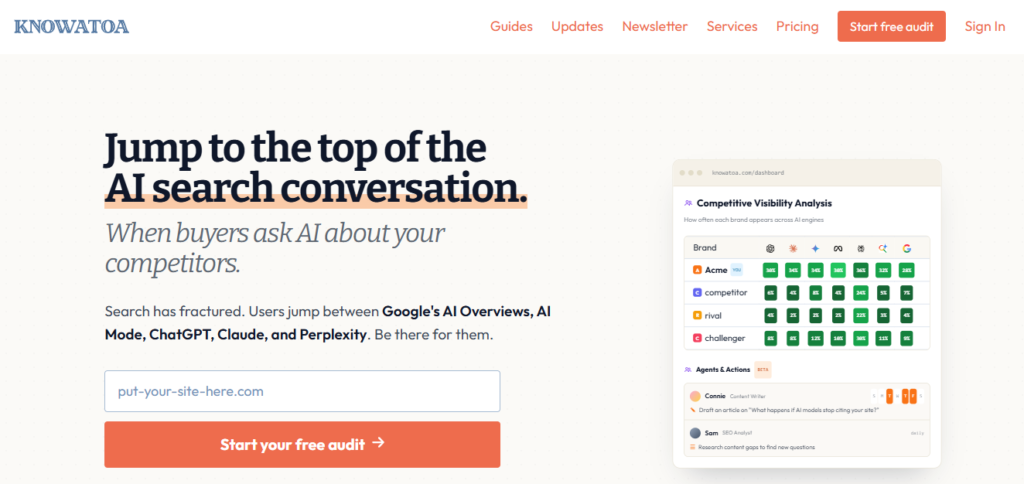
Knowatoa is an AI search monitoring platform that tracks how brands appear for specific buyer questions across ChatGPT, Claude, Gemini, Perplexity, Meta AI, Google AI Overviews, and AI Mode. It records brand mentions, AI citations Building, sentiment, competitor visibility, and changes over time. Its main advantage is the combination of prompt-level monitoring and technical access checks. Teams can see which questions competitors are winning and use the AI Search Console to detect whether bots such as GPTBot and Claude-Web can access important pages.
Key Features
- Question Tracking: Monitors custom buyer questions and suggests new prompts.
- Multi-Engine Coverage: Tracks visibility across seven AI search platforms.
- Competitor Analysis: Identifies questions where competing brands appear instead.
- AI Search Console: Detects crawler-access and robots.txt issues.
- Reporting Integrations: Connects with API, MCP, Looker Studio, and NinjaCat on higher plans.
Pros
- Covers seven major AI search platforms
- Tracks custom questions instead of relying only on generic keywords
- Combines visibility monitoring with AI crawler diagnostics
- Supports regional and multilingual monitoring
- Includes content-research and drafting agents
Cons
- Full platform coverage requires the Growth plan
- Advanced reporting is limited on the Starter plan
- It does not directly connect AI visibility to conversions or revenue
Pricing
- Starter: $59/month for ChatGPT, AI Overviews, and AI Mode
- Growth: $199/month for all seven platforms, expanded reporting, and integrations
- Enterprise: Custom pricing for larger teams and monitoring requirements
3. Peec AI
Best for detailed competitor and citation analysis
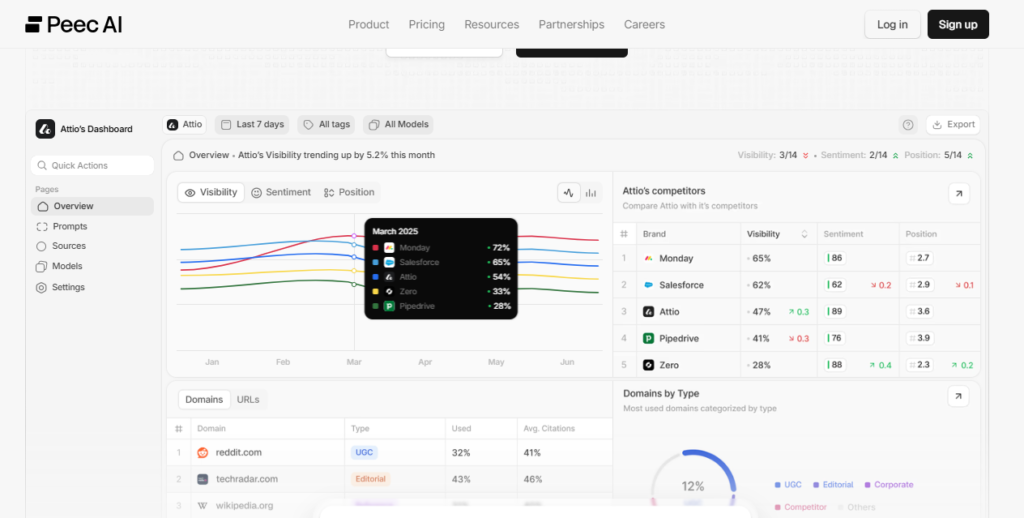
Peec AI is an AI search analytics platform that tracks brand visibility, position, sentiment, and share of voice across major AI platforms. Its strength lies in showing where competitors outperform your brand and which third-party sources influence those results. It is one of the best AI search monitoring tools for teams that want clear competitive benchmarks and source-level citation insights without an overly complex dashboard.
Key Features
- Prompt Tracking: Monitors custom prompts and groups them by search intent.
- Competitor Benchmarking: Compares visibility, position, sentiment, and share of voice.
- Citation Analysis: Identifies the domains and pages shaping AI responses.
- Brand Perception: Traces inaccurate claims and brand attributes to their sources.
- Actionable Recommendations: Suggests content, digital PR, and citation opportunities.
Pros
- Detailed competitor and citation reporting
- Clean and easy to navigate interface
- Daily tracking with unlimited users
- Strong prompt and brand-perception analysis
Cons
- Standard plans include only three models
- Additional models cost extra
- API access is limited to Enterprise
Pricing
Brand plans:
- Starter: $95/month for 50 prompts
- Pro: $245/month for 150 prompts
- Advanced: $495/month for 350 prompts
- Enterprise: Custom pricing and prompt limits
Agency plans:
- Essential: $245/month for about 111 daily prompts
- Growth: $495/month for about 277 daily prompts
- Scale: $795/month for about 722 daily prompts
- Comprehensive: Custom pricing with unlimited credits
Agency prompt capacity varies by selected models and tracking frequency.
4. GetMint
Best for turning AI visibility gaps into content opportunities
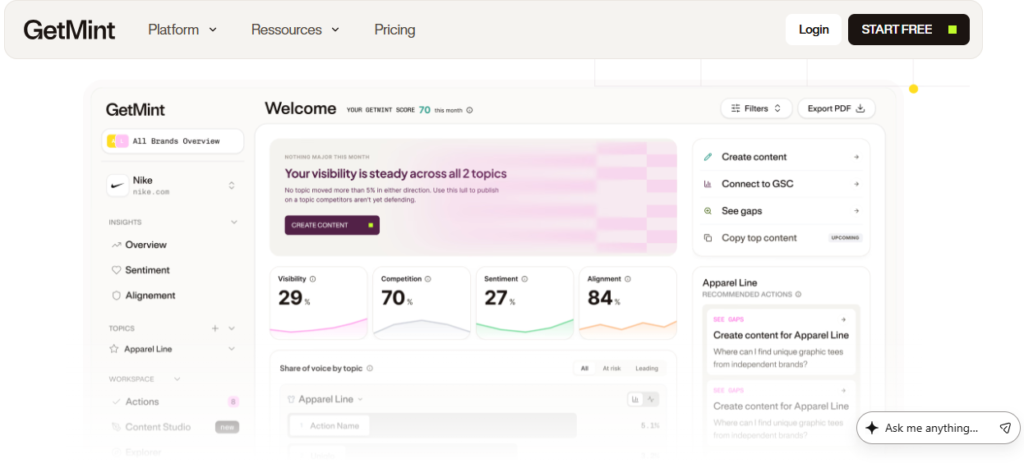
GetMint tracks brand mentions, citations, sentiment, and share of voice across major AI search and shopping platforms. Its main capability is connecting monitoring data with content production, distribution, and technical recommendations. GetMint is a strong option for teams that want to move quickly from finding visibility gaps to creating and publishing content designed to close them.
Key Features
- Multi-Engine Tracking: Monitors ChatGPT, Gemini, Claude, Perplexity, AI Overviews, and shopping assistants.
- Visibility Gap Analysis: Finds prompts where competitors appear but your brand does not.
- Content Studio: Creates briefs and articles based on missed prompts and cited sources.
- Mention Building: Identifies external websites and conversations where your brand should appear.
- AI Shopping Analytics: Tracks product positions, retailers, pricing, and competitors across shopping experiences.
Pros
- Connects monitoring directly with content creation
- Covers traditional AI search and product-shopping results
- Provides prioritized actions for each visibility gap
- Includes daily tracking and competitive analysis
Cons
- Starter includes only two AI models
- API and reporting integrations require custom pricing
- Content allowances may be restrictive for larger publishing teams
Pricing
- Starter: $80/month for 50+ prompts and two models
- Growth: $349/month for 300+ prompts and three models
- Enterprise & Agency: Custom pricing with unlimited brands, API access, advanced workflows, and dedicated support
5. Scrunch
Best for enterprise AI search monitoring and AI agent accessibility
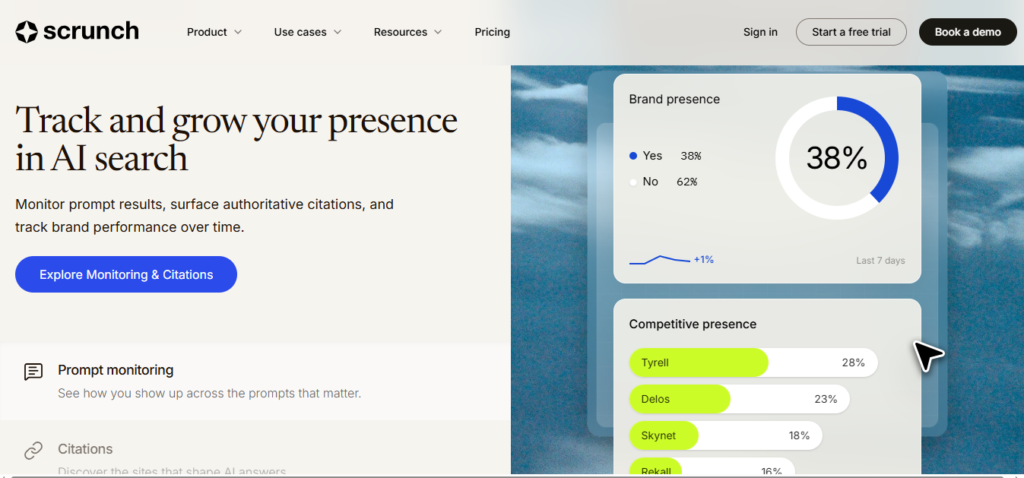
Scrunch combines AI search monitoring with tools that show how AI agents access and interpret a website. It tracks brand visibility, citations, competitors, sentiment, and prompt performance while helping technical teams identify pages that AI crawlers struggle to consume. Scrunch is best suited to enterprises that need to monitor AI visibility while improving how agents access and process their websites.
Key Features
- Monitoring and Citations: Tracks brand presence, prompts, competitors, sentiment, and cited sources.
- Agent Experience Platform: Serves AI-optimized content without changing the human-facing website.
- Agent Traffic: Shows which AI bots visit the site and which pages they access.
- Site Maps: Identifies crawl problems and pages that need optimization.
- AI Search Trends: Surfaces growing topics, estimated demand, and new prompt opportunities.
Pros
- Combines visibility data with technical agent analytics
- Supports enterprise security, APIs, and global deployments
- Provides detailed citation and competitor reporting
- Tracks both AI answers and crawler behaviour
Cons
- Core supports only four AI platforms
- Advanced features require custom Enterprise pricing
- Agent Traffic and CMS integrations may require technical setup
Pricing
- Core: $250/month for 125 prompts and four LLMs
- Enterprise: Custom pricing for nine LLMs
A seven-day free trial is available.
6. Goodie
Best for managing an end-to-end AEO program
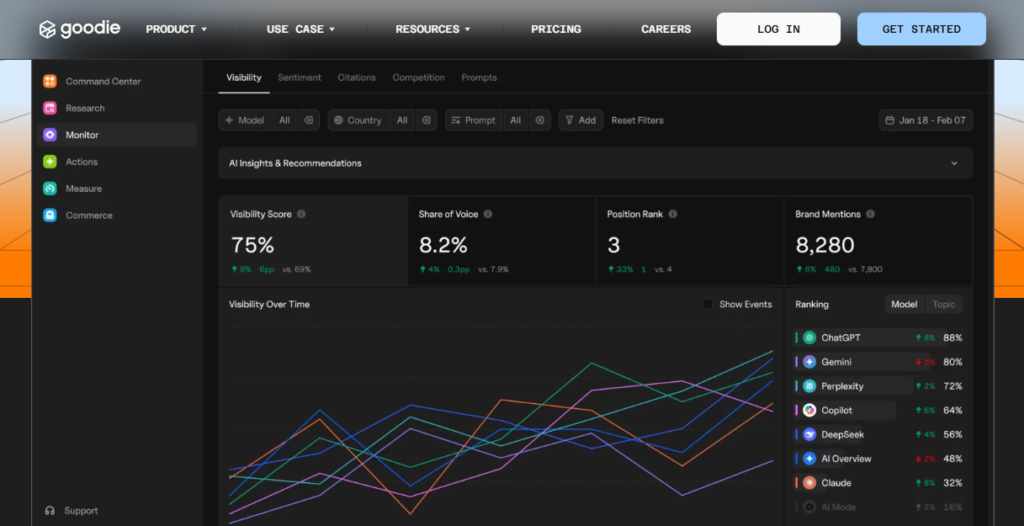
Goodie is another AI search monitoring tool you can use. It combines prompt research, AI visibility tracking, content optimization, crawler analytics, and revenue attribution. The platform is best suited to larger teams that want one tool for monitoring and optimizing their entire AEO program.
Key Features
- Prompt Research: Finds high-intent prompts using demand, seasonality, and competitive data.
- Visibility Monitoring: Tracks mentions, citations, sentiment, position, and share of voice.
- Optimization Actions: Prioritizes content, outreach, social, and technical improvements.
- AEO Writer: Creates structured content based on brand voice and citation gaps.
- Revenue Attribution: Connects AI traffic and visibility changes to conversions and revenue.
Pros
- Covers the complete AEO workflow
- Connects visibility data with revenue
- Includes content and technical optimization tools
- Supports AI shopping and crawler monitoring
Cons
- Entry pricing is higher than several competitors
- Full model coverage requires Enterprise
- The broad feature set may be excessive for basic monitoring needs
Pricing
- Explorer: $399/month for 100 prompts and three models
- Pro: Custom pricing for 250 prompts and additional models
- Enterprise: Custom pricing for 500+ prompts and multi-brand tracking
Bouns Read: Best LLM Tracking Tools 2026
How to choose the right AI search monitoring tool?
The right choice depends on your preferred AI platforms and reporting requirements.
- Need affordable visibility tracking combined with listicle and citation opportunities? Choose RankLLM.
- Want to monitor specific customer questions and check whether AI crawlers can access your website? Consider Knowatoa.
- Need to turn visibility gaps directly into briefs and publishable content? GetMint is a strong fit.
- Want detailed competitor benchmarking and source-level citation analysis? Choose Peec AI.
- Need enterprise monitoring, AI agent analytics, and advanced website accessibility tools? Consider Scrunch.
- Want one platform for prompt research, monitoring, optimization, content creation, and revenue attribution? Goodie is the better fit.
Before deciding, compare each platform’s AI model coverage, prompt limits, tracking frequency, integrations, reporting depth, and pricing.
FAQs
1. How is AI search monitoring different from traditional rank tracking?
Traditional rank tracking shows where a webpage ranks in search results. AI search monitoring shows whether an AI platform mentions, recommends, or cites your brand in its generated answers.
2. Which AI platforms should a monitoring tool cover?
At minimum, it should cover ChatGPT, Gemini, Perplexity, Claude, Google AI Overviews, and AI Mode. E-commerce brands should also consider tools that monitor AI shopping results.
3. How many prompts should I track?
Most businesses should begin with 20 to 50 important prompts. Include category searches, competitor comparisons, product questions, customer problems, and purchase-intent queries.
4. Can these tools improve AI visibility?
Yes, but indirectly. They identify missing content, citation gaps, competitor advantages, inaccurate information, and crawler issues that your team can fix to improve visibility.
5. How often should AI visibility be monitored?
Daily tracking is best for active campaigns and competitive industries. Weekly tracking is usually enough for smaller teams that mainly want to measure long-term changes.