There is a quiet shift happening in how people discover products, services, and brands. More users than ever are skipping the Google results page entirely and going straight to ChatGPT, Perplexity, Gemini, or Claude with their questions. And when they ask — “What’s the best CRM for a small team?” or “Which SEO platform should I use in 2026?” — they expect a direct, confident answer, not ten blue links to click through.
The problem? Most brands have no idea whether they appear in those answers. They’ve spent years optimizing for Google and have never thought about AI citation building — the practice of earning a place in the sources that AI engines actually read and cite. This guide explains what AI citation building is, why it matters more than traditional SEO for AI search, and exactly how to do it.
| 60% Of AI answers cite fewer than 5 sources per response | #1 Google rank does not guarantee AI visibility | 4× More likely cited when across multiple trusted domains |
What Is AI Citation Building?
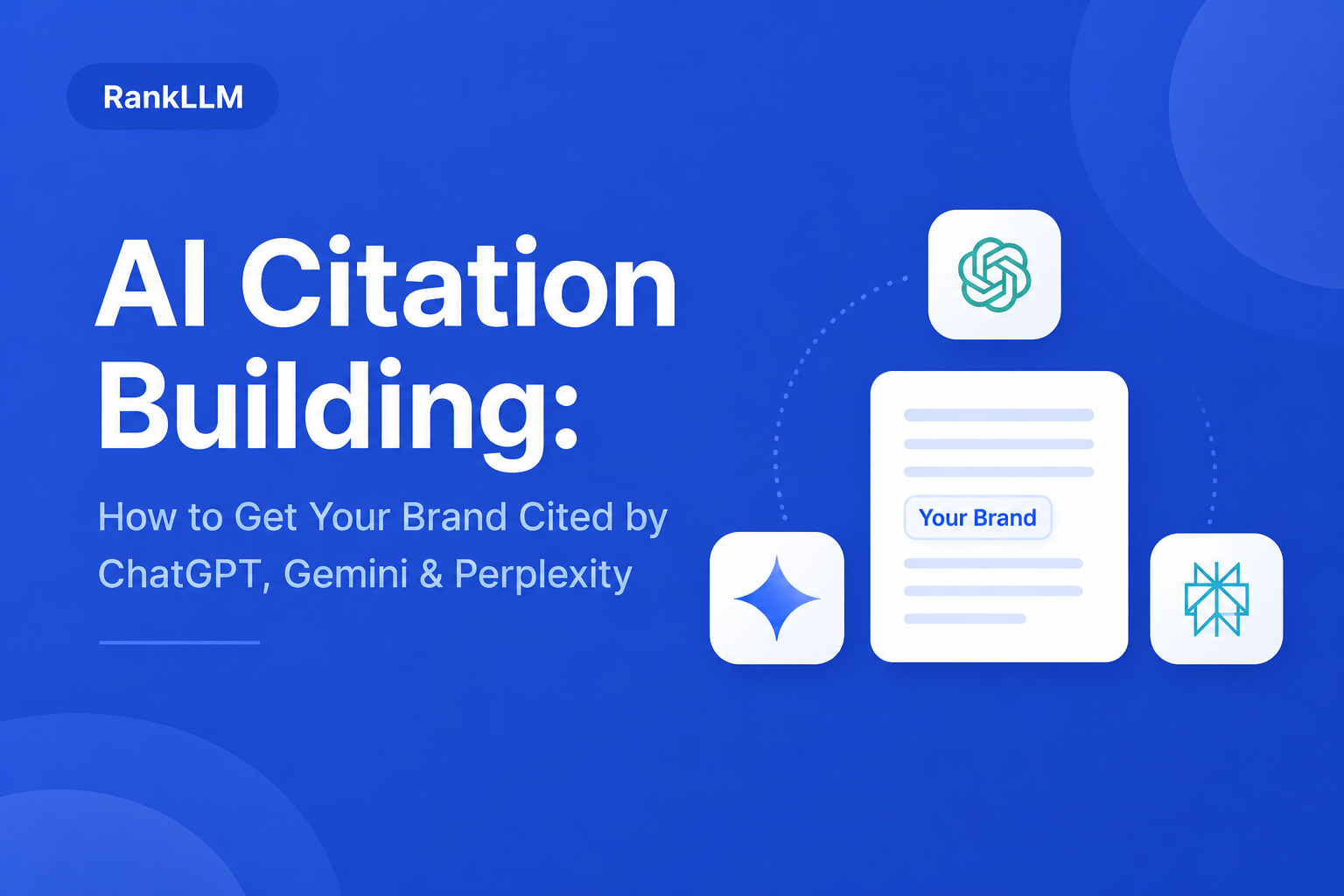
AI citation building is the work of placing your brand inside the high-authority articles, listicles, and comparison pages that AI engines like ChatGPT, Gemini, Claude, and Perplexity rely on when forming their answers. When a user asks an AI assistant a question, the model doesn’t crawl the entire web in real time (except tools like Perplexity, which uses live retrieval). Instead, it draws from a curated set of trusted pages it has learned to associate with quality answers in your category.
If your brand appears consistently across those trusted pages — the “best of” listicles, the head-to-head comparisons, the expert roundups — the AI starts naming you in its answers. If you don’t appear in those pages, you’re effectively invisible, regardless of how well your own website ranks.
“AI engines don’t discover brands the way Google does. They inherit consensus from a small set of trusted sources. If your brand isn’t in those sources, it doesn’t exist to the model.”
Why Google Rankings Aren’t Enough Any More
For over two decades, search engine optimization meant one thing: rank higher on Google. If you were on page one for your target keywords, you captured organic traffic, built authority, and grew your brand. That playbook still has value — but it no longer covers the full picture.
As we explored in our deep-dive on LLM ranking and the future of search visibility, AI-generated answers are now intercepting a growing share of informational and commercial queries before users ever see a traditional results page. A brand can hold the number-one position on Google for a competitive keyword and still be completely absent from the ChatGPT or Perplexity answer to the same question — because those tools cite their own trusted sources, not the Google ranking order.
This is the core gap that AI citation building is designed to close. It’s not a replacement for SEO; it’s the layer that completes your visibility strategy for the era of AI search.
How LLMs Choose the Sources They Cite
Understanding why AI engines cite certain pages — and ignore others — is the foundation of an effective citation strategy. Large language models are trained on enormous corpora of web content, and they develop strong associations between certain domains and authoritative answers in specific niches. During training, sources that appeared frequently alongside reliable, well-structured information were weighted more heavily.
After training, when a model generates a response, it draws on these learned associations. Domains that showed up in hundreds of well-regarded “best of” lists, comparison articles, and expert roundups during training became the model’s mental shortlist of reliable sources. Getting cited by AI engines means getting into that shortlist — and that requires presence across multiple independent, high-quality pages that already sit in the model’s trust network.
The sources AI engines trust most
- Independent comparison and review sites with editorial standards
- High-DR industry publications and niche authority blogs
- Structured “best of” listicles with clear methodology
- Long-form “X vs Y” head-to-head comparison articles
- Buyer’s guides from established media outlets
- G2, Capterra, and other structured review aggregators
AI Citations vs. Traditional Backlinks
It’s tempting to treat AI citation building as a rebranded version of link building. There is overlap — many placements that earn AI citations also deliver traditional backlinks — but the goals and mechanics are meaningfully different.
| Traditional Backlinks | AI Citations |
| Built to pass authority to Google’s algorithm | Built to create source consensus across AI engines |
| Measured in Domain Rating and referring domains | Measured in citation share and AI mention frequency |
| Win blue-link rankings on results pages | Win named recommendations in AI-generated answers |
| One high-DR link can move the needle alone | Requires consistent presence across multiple independent sources |
| Anchor text and link placement matter most | Context, category match, and co-citation matter most |
The key difference is consensus. Google’s algorithm can be moved by a single powerful backlink. AI engines require the model to encounter your brand across multiple independent articles before it develops confidence in recommending you.
💡 Key Insight: As we covered in our guide to what LLM ranking means for modern businesses, citation share is quickly becoming one of the most important metrics for brands competing in AI search — yet most companies aren’t tracking it at all.
How to Get Cited by ChatGPT, Perplexity, Gemini, and Claude
There is no single tactic that guarantees AI citations — it’s a compounding strategy built on consistent presence. But there are clear, repeatable steps that move the needle.
-
Map the sources AI already cites in your niche
Before you can earn citations, you need to know which pages the AI engines are pulling from when they answer questions in your category. Run your target prompts through ChatGPT, Perplexity, and Gemini and note which sources appear in the responses. These are your priority targets for placement.
-
Earn placements on those pages
Once you’ve identified the trusted source pages, the goal is to get your brand included — through editorial outreach, contributed content, or paid placements where appropriate. A mention on one of these already-cited pages carries far more weight than a mention on a page the AI has never encountered.
-
Build cross-source consensus
Aim to appear in at least five to ten independent, relevant articles before expecting consistent AI mentions. AI engines look for agreement. When they see the same brand named in multiple unrelated sources, they gain confidence and start including it in answers.
-
Optimize your own pages for AI extraction
- Open every key page with a clear, direct definition of what you do
- Use question-style H2 and H3 headings that match how users prompt AI tools
- Add FAQ sections with concise, factual answers
- Implement structured data (FAQ schema, Product schema, Organization schema)
- Keep content updated — Perplexity and Google AI Overviews heavily favor freshness
Building a Full GEO Strategy
Generative Engine Optimization — GEO — is the broader discipline that AI citation building sits within. While citation building focuses on earning placements in external sources, GEO also covers how you structure your own content to be extracted and quoted by AI engines. The two work together: external citations give AI engines confidence in your brand, while well-structured on-site content gives them clean, quotable material to use in their answers.
A complete GEO strategy involves tracking your citation share across engines, monitoring which competitor brands are getting cited instead of you, identifying new placement opportunities as AI engines update their source libraries, and continuously adding fresh, well-structured content to your own domain. Platforms like RankLLM’s AI Authority tool automate this by mapping the exact pages AI cites in your niche and surfacing live placement opportunities.
How to Measure AI Citation Success
Unlike traditional SEO, AI citations don’t show up in Google Search Console. You need to track them directly by running your target prompts through each AI engine and recording whether your brand appears — and in what position. Do this consistently over time to build a picture of your citation share and how it changes as you execute your strategy.
Key metrics to track include: overall citation frequency across engines, citation share relative to named competitors, which source pages are generating the most citations, and how quickly new placements appear in AI answers (Perplexity is fastest; ChatGPT takes longer to reflect new placements).
Ready to See Your AI Citation Opportunities?
Find out which pages AI engines cite in your niche — and how to get your brand inside them. Start free with RankLLM →
Frequently Asked Questions
What is AI citation building?
AI citation building is the practice of getting your brand included in the trusted articles, listicles, and comparison pages that AI engines like ChatGPT, Gemini, Claude, and Perplexity cite when answering questions in your niche.
Is AI citation building the same as link building?
They overlap but serve different purposes. Traditional link building passes ranking authority to Google’s algorithm. AI citation building creates the source consensus that makes AI engines recommend your brand. Many placements deliver both benefits simultaneously.
How long does it take to appear in AI answers?
It depends on the engine. Perplexity uses live retrieval and can surface new placements within days. ChatGPT and Gemini build on trained associations, so consistent cross-source presence can take weeks to months before you appear regularly.
Do I need to rank on Google to get cited by AI engines?
No — and this is a crucial point. A brand can rank number one on Google and still be absent from AI-generated answers. AI engines source from their own trusted page sets, which don’t mirror Google’s ranking order. You need a dedicated AI citation strategy alongside your traditional SEO.
How do I track my AI citation share?
Track it by running your target prompts through each AI engine and recording whether your brand appears. RankLLM automates this — it runs prompts across ChatGPT, Gemini, Claude, and Perplexity and tracks your citation frequency, competitor mentions, and source pages over time.